
Reviewed · 2-DAY EXPERIENCES
2 Days Harar Tours
Harar’s most unusual sight is not behind glass in a museum. It is a wild hyena waiting at the city edge for a man to offer it meat. That nightly feeding is the hook, but the real pleasure comes from walking through the old walled city, where narrow lanes, painted homes, mosques, shrines, and busy gates bring you close to daily life.
I like this tour for two clear reasons: the compact two-day plan covers Harar’s main sights, and the pickup, vehicle, meals, entrance fees, and hotel arrangements keep the trip simple. I also like the mix of culture and scenery, from the Sheriff Museum and Rimbaud House to the rock formations outside Babile.
The main consideration is timing. The Babile Camel Market operates on Mondays and Thursdays, so the second day is less rewarding if your visit falls on another day. The domestic flight from Addis Ababa is also not included in the $300 price.
Key points at a glance
- Watch Harar’s hyena feeding ritual: See local feeders offer meat to wild hyenas just outside the old city.
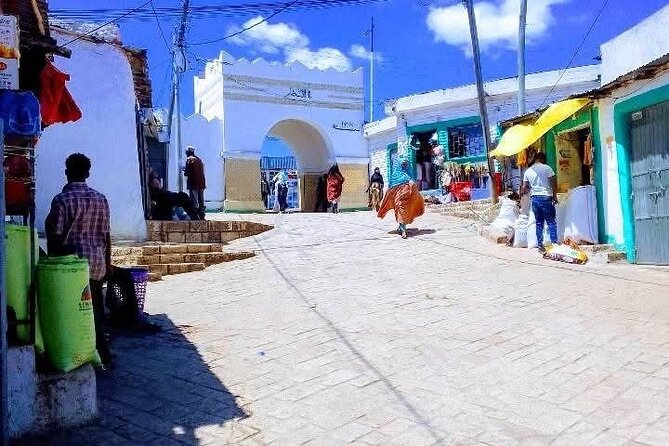
- Walk inside the Jegol wall: Explore Harar’s old quarter, built around narrow lanes and five historic gates.
- Visit three distinctive cultural sites: The Sheriff Museum, Rimbaud House, and Harari National Cultural Center each add a different layer to the city.
- Time Babile carefully: The camel market takes place every Monday and Thursday and is the strongest reason to plan your dates around it.
- Travel with a small group: The maximum group size is 15 people, with airport pickup in Dire Dawa.
- Compare the full cost honestly: The $300 fee includes many local expenses, but not the flight from Addis Ababa.
Why Harar feels different from other Ethiopian cities
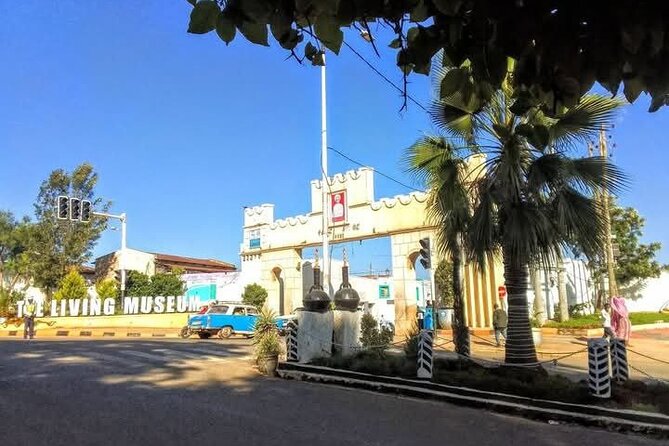
Harar is an old trading center in eastern Ethiopia, close to the meeting point of several cultures and routes. Its old quarter is surrounded by the Jegol wall, built in the 1560s during the rule of Emir Nur to protect the city from attacks.
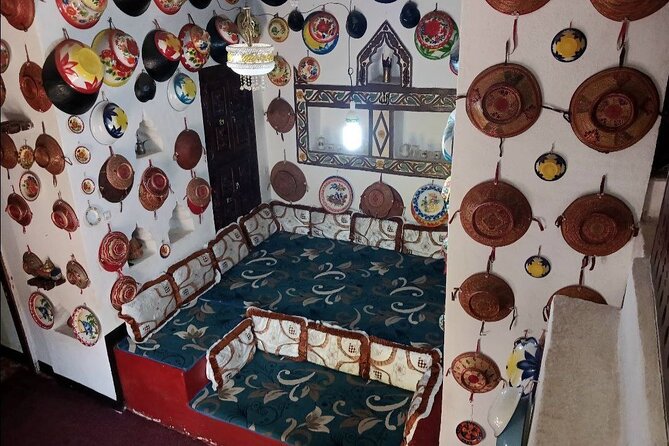
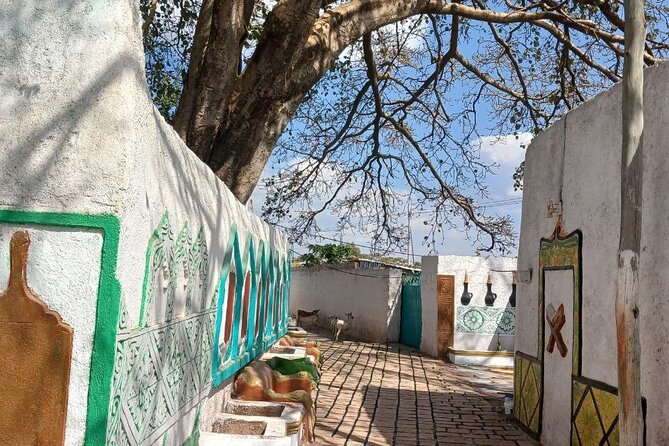
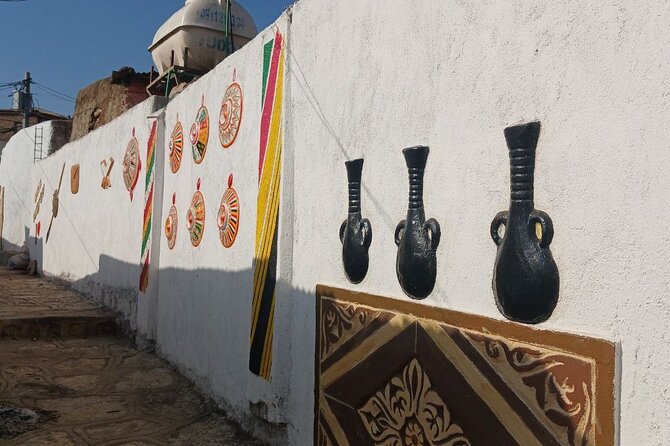
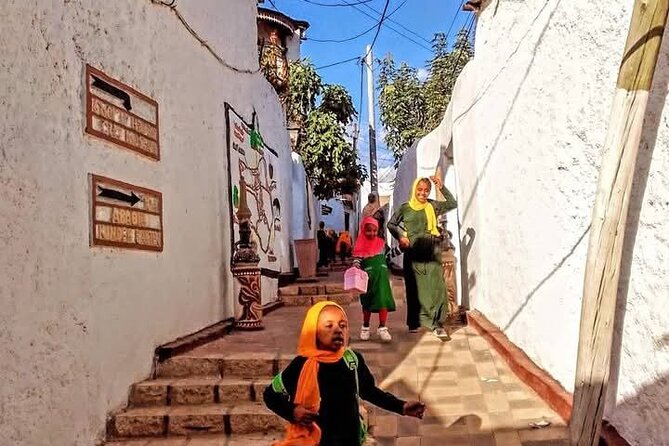
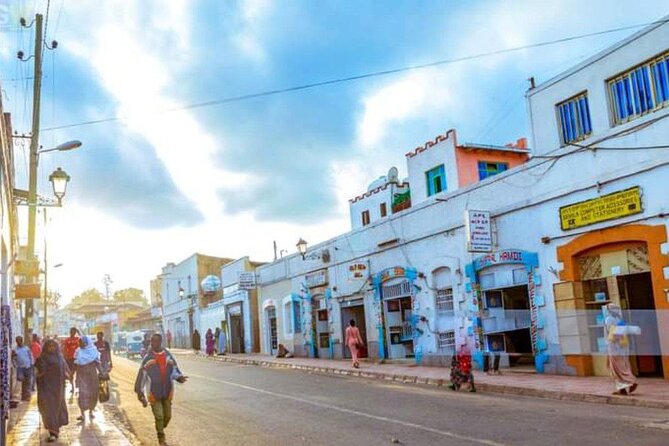
That wall still gives the city a clear shape. Five gates lead into the old quarter, and once you pass through one, the streets narrow quickly. You will walk past colorful houses, mosques, shrines, small shops, and market stalls. This is not a monument district preserved only for sightseeing. People still live and work inside it.
Harar is also known for its welcoming social culture. The city’s friendliness is reflected in its most famous animal tradition. Hyenas, normally feared as powerful predators, are fed by local men and are part of a long-running relationship between the animals and the people of Harar.
I would choose this trip if you want a place that feels distinct from Ethiopia’s better-known historic circuit. You are not simply moving from one old building to another. You are seeing a living city with strong local customs, a compact center, and a memorable evening ritual.
More Harar and Dire Dawa trips:
- 6 Days Lalibela, Omo Valley and Harar
★ 5.0 · 15 reviews - 5 Days Tour to World Heritage–listed Harrar, Dire Dawa and Awash NATIONAL PARK
★ 4.5 · 10 reviews - 2 Days Tours To Harar Hyena Feeding & Walled City Tours
★ 5.0 · 3 reviews
Day 1: From Addis Ababa to Dire Dawa, then Harar
The tour begins with a flight from Addis Ababa to Dire Dawa. That domestic flight is separate from the tour price, so you need to arrange and budget for it before the trip.
At Dire Dawa International Airport, a representative meets you with a sign bearing your name. From there, you drive to Harar, check into your hotel, and have time to rest before the city walk. The published start time is 9:00 am, though the exact flow depends on your flight and transfer arrangements.
This airport pickup is useful because Dire Dawa is the practical arrival point for the tour. You do not need to find the hotel or negotiate a transfer after landing. The air-conditioned vehicle also matters in eastern Ethiopia, particularly after a flight and road journey.
The maximum group size is 15 people. That is small enough for a more manageable walk through Harar’s lanes, though it is not the same as a private tour. If you want a private arrangement, past departures have been guided by people including Alex, Mickey, and Tilahun, but you should confirm your assigned guide when booking.
Walking Harar’s old quarter and five gates
The city tour is the heart of the first day. Expect about eight hours of sightseeing, including the old city and its cultural sites. The pace involves walking through narrow lanes, so comfortable shoes are more useful than anything formal.
The Jegol wall gives the old quarter its sense of place. Entering through one of the five gates helps you understand how compact the historic city is. Thousands of people live within roughly one square kilometer, and that density makes the walk feel active at almost every turn.
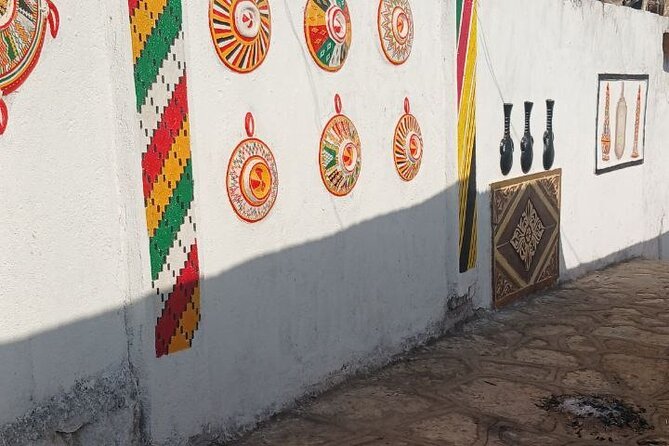
I especially like the colorful Harari houses. They give the lanes a strong visual character, and the city is well suited to photography. Old Peugeot cars, market goods, painted walls, and activity around the gates provide plenty to look at without needing a grand viewpoint.
You should still keep your camera use thoughtful. This is a lived-in neighborhood, not a stage set. Ask your guide when you are unsure about photographing people, homes, or religious places. The supplied information does not state a separate photography rule, so respectful judgment is the safest approach.
Three stops that give the city context
The Sheriff Museum is located in the former honeymoon house of Ras Teferi. That detail gives the building a personal connection to Ethiopia’s royal past, rather than presenting it as just another historic structure.
Rimbaud House adds a different angle. Its connection with the French poet Arthur Rimbaud reflects Harar’s long contact with foreign traders, writers, and visitors. It is a useful stop if you enjoy places where local history and international curiosity meet.
The Harari National Cultural Center focuses more directly on Harari life and culture. Together, these three stops keep the afternoon from becoming a simple walk through old streets. You get a mix of political history, outside influence, and local traditions.
The tour also includes a local market and visits to colorful Harari homes. These stops are valuable because they show how the city functions day to day. Markets can be crowded and visually intense, but they also give you a better sense of what people buy, sell, cook, and carry than a museum alone.
More 2-Day Tours in Ethiopia:
- 2 Days Private Tour in Addis Ababa Ethiopia
★ 5.0 · 36 reviews - 2 Days Wildlife Safari to Awash National Park
★ 4.5 · 21 reviews - 2 Days 1 night tour to Lalibela Rock-hewn churches
★ 5.0 · 12 reviews - Two Days Tigray Churches Trip
★ 5.0 · 10 reviews
The hyena feeding after dark
The hyena feeding is the most unusual part of the first day. The ritual takes place daily at a designated spot just outside the city walls. Local men known as hyena feeders bring pieces of meat and offer them to the animals.
The sight can feel startling at first. Hyenas are formidable African predators, yet here they approach people in a controlled tradition that has continued for years. The experience is not a wildlife safari. You are watching a local custom built around a close, uneasy, and carefully managed relationship between people and wild animals.
The entrance fee for the hyena feeding is included. The activity itself is listed as about one hour, making it easy to fit after the main city walk.
I would treat this as a cultural performance with a real animal element, not as a promise that you will see a large number of hyenas at close range. The appeal is the tradition and the setting. Your guide can also help explain what you are seeing and where to stand.
Day 2: Babile’s camels and the Valley of Marvels
The second morning takes you from Harar toward Babile. The key question is your travel date. Babile’s camel market takes place every Monday and Thursday, when Somali and Oromo farmers come to sell camels, goats, and cattle.
On a market day, this is a strong addition to the tour. You see livestock trading as part of ordinary regional life, rather than viewing animals only in a scenic setting. The camel market also gives you a window into the links between Harar, nearby farming communities, and the wider eastern Ethiopian region.
If your visit does not fall on Monday or Thursday, the market may not be worth the detour. The itinerary allows for a different plan on the return to Dire Dawa, including Koremi, so ask how your date will be handled before you commit.
The Valley of Marvels is the other major stop outside Babile. Its best-known feature is a group of balancing rock formations. Large stones appear to rest on the tips of smaller rocks, creating striking shapes against the surrounding scenery.
This is a short stop, listed at roughly 45 minutes in the detailed plan, so do not expect a full-day geology outing. Its value is visual: the formations make a good contrast with Harar’s dense lanes and colorful buildings.
Koremi as a backup cultural stop
Koremi is described as older than Harar, with very old stone houses. It is included as an alternative when Babile is not operating as a market.
That makes Koremi a useful backup, but you should not assume it will feel like a full replacement for the camel market. The two stops offer different experiences. Babile is about people, livestock, and trade. Koremi is about an older settlement style and stone construction.
The itinerary also includes about an hour focused on Harar’s photography. This may sound like a small addition, but it makes sense. The city’s alleys, colorful homes, gates, markets, old Peugeots, and people provide subjects at almost every turn.
If you enjoy photography, use this time to slow down. The city rewards observation more than a rushed checklist. If you are not a photographer, the same hour still gives you room to explore without feeling that every stop must be completed in minutes.
What the $300 price covers
The $300 per-person cost includes dinner, breakfast, two lunches, an air-conditioned vehicle, pickup and drop-off, the hyena feeding entrance fee, museum and Jegol wall entrance fees, and government tax.
That is a fair package if you value convenience. You are paying for a two-day local program with transport from Dire Dawa, accommodation arrangements, meals, and several entry costs handled together. You also avoid having to organize a separate transfer, city guide, and evening visit.
The domestic flight from Addis Ababa is not included. This is the biggest extra cost to consider, and it means the true budget for the trip will be higher than $300.
The description does not provide a hotel name or room category, so ask what accommodation is planned. It also does not give exact meal menus or vehicle seating details. Those are reasonable questions to settle before payment, especially if you have dietary needs or prefer a private room.
Who will enjoy this two-day plan
I would recommend this experience to someone who wants a compact introduction to Harar without arranging every piece alone. It suits you if you enjoy walking, local markets, unusual customs, photography, and short road trips with a clear schedule.
It also works for a wide range of ages and abilities because the main requirement is walking. One past arrangement included a three-year-old child and two people aged 78, with the practical advice that you should be able to walk. That does not remove the need to judge your own comfort, but it suggests the itinerary is not built around strenuous hiking.
Families should discuss the hyena feeding in advance if young children are uneasy around large animals. The tour is generally suitable for most participants, and public transportation is nearby, but the supplied details do not promise special accessibility equipment.
A maximum of 15 people keeps the group from becoming unwieldy. Still, if personal attention matters most, ask whether a private guide can be arranged and which guide will lead your departure.
Booking and cancellation details
Confirmation is provided at the time of booking, and the activity begins at Dire Dawa International Airport. The tour ends back at that meeting point.
Free cancellation is available up to 24 hours before the experience begins for a full refund. Cancellations or changes made less than 24 hours before the start time are not accepted for a refund. The tour also requires a minimum number of participants, and if that minimum is not reached, you are offered another date or experience, or a full refund.
Plan around the Babile market days before booking. If Monday or Thursday does not fit, the trip can still work, but the second morning will rely more on the Valley of Marvels, photography, and possibly Koremi.
Should you book the 2 Days Harar Tour?
Book it if you want Harar’s major sights in a short, organized trip and you value having airport pickup, a vehicle, meals, and entrance fees arranged for you. The hyena feeding, old-city walk, and Babile market create a memorable mix that is hard to reproduce with a simple city transfer.
Think twice if you want a slow, private program or if your schedule cannot include Monday or Thursday for Babile. Also add the flight from Addis Ababa to your calculation.
For most visitors with two days to spare, this is a practical way to reach one of Ethiopia’s most distinctive cities. Confirm the hotel, guide, flight timing, and Babile plan first, then the $300 package offers solid local coverage without making you manage every detail yourself.
FAQ
Where does the tour begin?
The tour begins at Dire Dawa International Airport in Ethiopia.
Where does the tour end?
The activity ends back at the meeting point in Dire Dawa.
What time does the tour start?
The stated start time is 9:00 am.
Is pickup included?
Yes. Pickup and drop-off are included, with airport pickup at Dire Dawa International Airport.
Is the flight from Addis Ababa included?
No. The domestic flight from Addis Ababa to Dire Dawa is not included in the tour price.
What is included in the $300 price?
The price includes dinner, breakfast, two lunches, an air-conditioned vehicle, pickup and drop-off, government tax, the hyena feeding entrance fee, and entrance fees for the museums and Jegol wall.
When does the Babile Camel Market take place?
The Babile Camel Market takes place every Monday and Thursday.
What happens if the tour is not on a Babile market day?
The itinerary says Babile may not be worth visiting outside market days, and the return route may include Koremi instead.
How large is the group?
The tour has a maximum of 15 participants.
Can I cancel for a full refund?
Yes. You can cancel at least 24 hours before the experience starts for a full refund. Cancellations made less than 24 hours before the start time are not refunded.
Just added around Ethiopia
- Best of Addis Privet Guided city Tour★ 5.0 · 6 reviews
- Debre Libanos Monastery & Scenic Portuguese Bridge Tour★ 5.0 · 4 reviews
- Addis Night Life yod Abissinia★ 3.8 · 4 reviews
- Day trip Adadi Mariam, Melka Kunture and Tiya stele★ 3.1 · 5 reviews
- Addis Ababa: Entoto hill and Mercato Market layover tour★ 5.0 · 5 reviews
- A perfect day trip to Lake wenchi from Addis Ababa★ 5.0 · 3 reviews
- Addis Ababa city tour from Bole airport and All Hotels★ 4.0 · 3 reviews
- Addis Ababa Essentials: Flexible Full-Day City Sightseeing★ 5.0 · 3 reviews
2-Day Experiences, compared.

2 Days 1 night tour to Lalibela Rock-hewn churches
Read our review →
Browse the lists this tour appears in